All articlesAudit Insights
Audit Failures: Big Un Limited (Big Review TV) — Australia
Smart Audit Team · 11 min read · 19 Oct 2026
AUDIT FAILURES
Big Un Limited (Big Review TV) — Australia
How a financing arrangement became “revenue”, and how a $12,005 testing threshold excluded a $12,000-per-invoice revenue stream
Setup
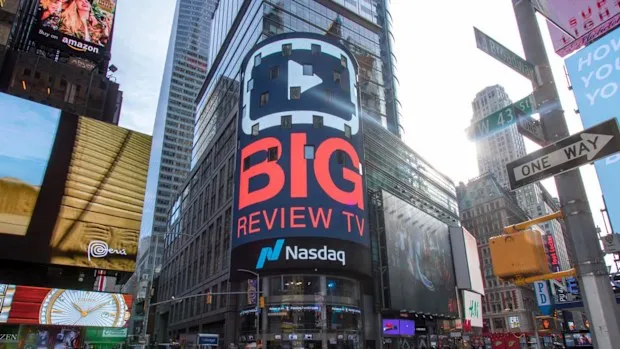
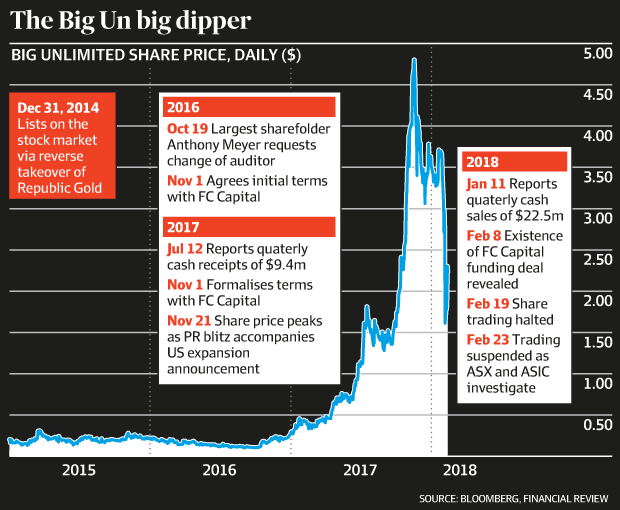
Big Un Limited sold $12,000 promotional “TV show” packages to small businesses through its subsidiary Big Review TV. The idea dates from 2012, the subsidiary was established in 2013, and the group reached the ASX in December 2014 through a reverse takeover of Republic Gold, a dormant mining shell, raising $3 million on listing.
The market treated the result as a commercial triumph. The shares went from $0.105 in June 2016 to $1.085 in June 2017, and peaked at $4.79 on 21 November 2017, a market capitalisation of $688.79 million. Reported quarterly cash receipts climbed from $5.6 million to $9.4 million to $15 million across 2017.
It did not unravel from inside. The Australian Financial Review published its first investigation in February 2018, the ASX put a series of questions to the company, the shares were suspended on 21 February 2018, and ASIC opened an investigation. Big Review TV went into voluntary administration in May 2018. Big Un was delisted in August 2018 and is now in liquidation.
The cast
- Richard Evertz, also known as Richard Evans, chief executive. Convicted in September 2026 of communicating inside information. Sentenced to one year nine months by intensive correction order with 400 hours of community service, and disqualified from managing corporations for five years.
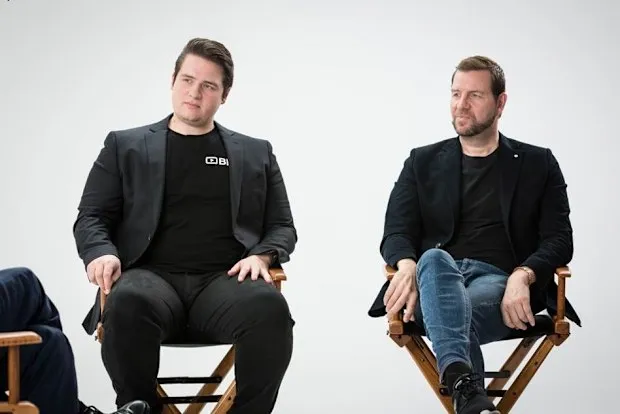
- Brandon Evertz, founder and public face of Big Review TV.
- Andrew Corner, chief financial officer. Charged with insider trading in 2023; the charges were discontinued in March 2026 after a hung jury.
- Graham Rothesay Swan, Rothsay Auditing, lead auditor for FY2017. Pleaded guilty and was convicted in August 2022 for failing to conduct the audit in compliance with auditing standards. Fined $2,000.
- Jakin Leong Loke, Ecovis Clark Jacobs, engagement team member. Registration suspended for 12 months.
- First Class Capital (FC Capital), the financier, led by Brad Prout. Its deferred-payment product for small businesses was branded Finstro.
Circular self-financing revenue
Circular self-financing revenue is revenue whose cash inflow originates from a party connected to the company rather than from the customer, and which creates an obligation back to that same party.
The agreed facts record that a large proportion of Big Un’s revenue came from a sponsorship agreement dated 8 December 2015 between Big Review TV and First Class Securities Pty Ltd, a subsidiary of FC Capital. Revenue was recorded when a customer entered a preliminary contract under that agreement, at a point when the customer had no obligation to pay. The unearned portion was transferred to deferred revenue at month end.
That single agreed fact is the heart of the case. Revenue was recognised at the moment a free trial was signed, not at the point a customer became contractually bound.
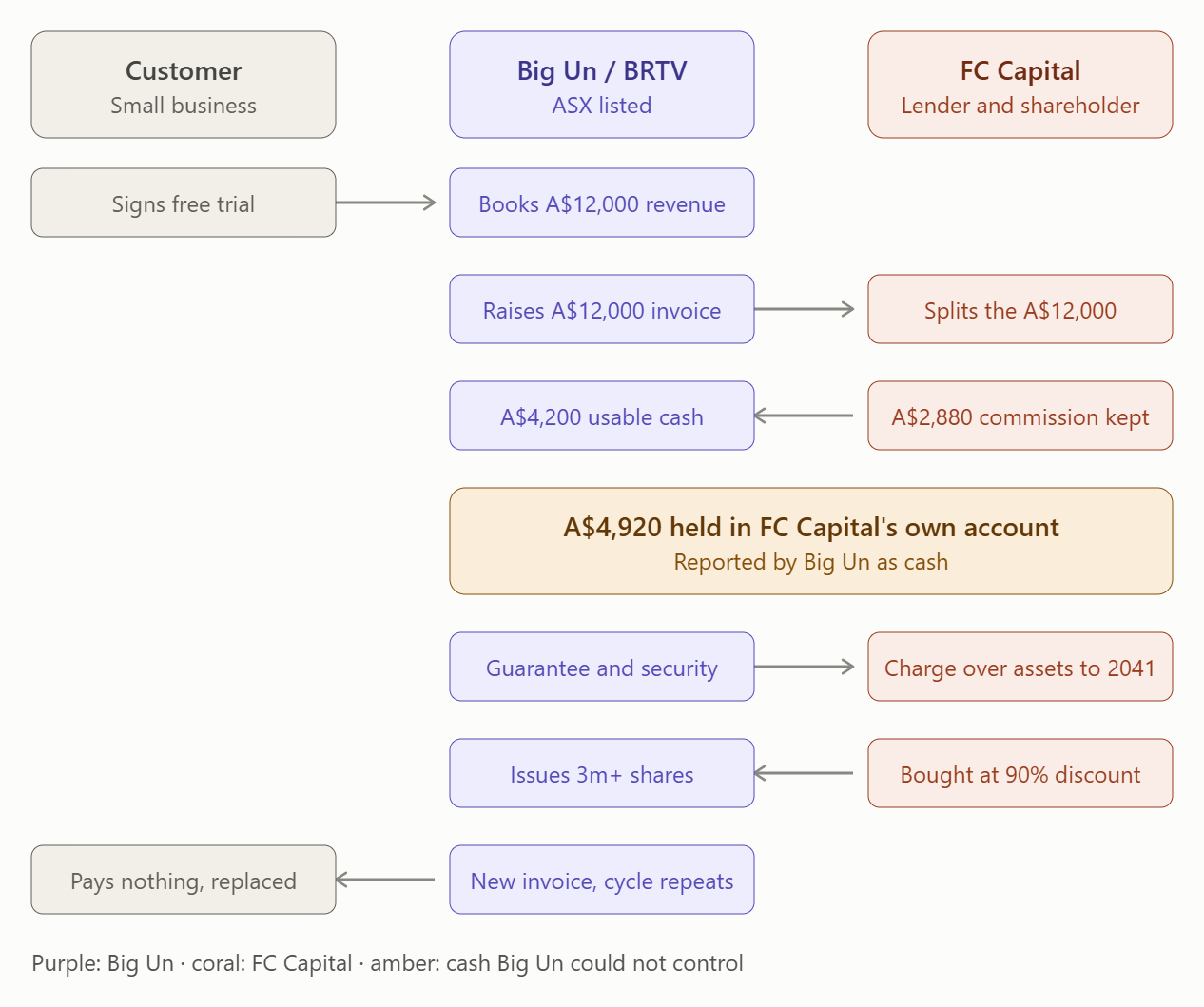
The mechanics worked as follows. A customer agreed to have a video filmed as a free trial. If they liked it they could pay $1,000 a month for a year, or $12,000 up front. Most declined, and Big Review TV was permitted to substitute another free-trial customer in order to retain the funding. It raised a $12,000 invoice against FC Capital, which advanced funds and retained 24 per cent as commission. The balance was split between an FC-nominated security deposit account and a working capital account, and Big Un remained liable for whatever customers did not pay. One published account puts the split at $4,200 released, $2,880 commission and $4,920 retained in an FC-controlled account that Big Un nonetheless reported as its own cash.
Big Un confirmed the 24 per cent commission in its ASX responses and disclosed that it had inadvertently breached Listing Rule 3.10.3 by not announcing an agreement to issue shares. FC Capital held roughly $9.3 million of Big Un shares bought at $0.20 while the market traded at $3.31, and held a general security agreement over Big Review TV’s assets running to 2041.
So the counterparty funding the revenue was simultaneously a commission earner, a secured creditor and a discounted shareholder. Every pillar of the growth story pointed back to one party.
Two figures from the AFR’s reporting show the scale. Around 90 per cent of a quarter’s $20 million of reported cash sales were Finstro-sponsored. And roughly $10,000 of interest was earned on about $30 million of reported cash, which is arithmetic no auditor should have to be told twice.
What each $12,000 of “revenue” actually was
| Amount | Reported as | In substance | |
|---|---|---|---|
| Released to Big Un | $4,200 | Receipts from customers | Secured borrowing |
| Commission to FC Capital | $2,880 | Not visible | Finance cost |
| Held in FC-controlled account | $4,920 | Cash and equivalents | Restricted |
| Paid by the actual customer | $0 | — | — |
| Obligation created | $12,000 | Nothing | Guaranteed debt |
The materiality failure
This is the part every audit manager should read twice.
The agreed facts record that overall materiality was set at $120,050, calculated as 10 per cent of net assets and 1 per cent of gross revenue, each given a 50 per cent weighting. Performance materiality was set at 100 per cent of overall materiality rather than below it. The clearly trivial amount was set at $12,005, being 10 per cent of performance materiality, which resulted in the exclusion from audit procedures of all invoices under the sponsorship agreement with First Class Securities. That was a significant source of the company’s revenue. No independent assessment of the circumstances of the engagement was made before materiality was set; the practice followed was to set both figures at around $100,000, and the conceptual distinction between the two was not understood.
The invoices were $12,000. The threshold at which the audit stopped looking was $12,005.
Whether that threshold was chosen for its effect is not something the public record establishes, and ASIC accepted that the conduct involved no dishonesty or deliberate impropriety. What the record does establish is more uncomfortable. The threshold was derived mechanically from figures the company itself had inflated. Strip out the overstated revenue and the deficient net assets, and overall materiality falls to roughly $20,000, the clearly trivial amount to around $2,000, and every sponsorship invoice comes back into scope. The inflated accounts raised the bar that kept the inflation untested. Design would have produced the same outcome.
1. Performance materiality must be lower than overall materiality. ISA 320 (SSA 320, ASA 320 as applied here) requires performance materiality to be set below materiality for the financial report as a whole, precisely to absorb undetected and uncorrected misstatement. Setting it at 100 per cent removes the buffer the standard exists to create.
2. A clearly trivial threshold is not a sampling filter. It identifies misstatements too small to accumulate. It was never intended to define a population out of scope. Where a revenue stream consists of thousands of identically priced transactions, a per-item threshold set anywhere above the unit price excludes the entire class. The aggregate, not the item, carries the risk.
3. Materiality must be set for the entity in front of you. A firm-wide habit of “about $100,000” is not a judgement. ISA 320 also requires the auditor to consider whether particular classes of transactions warrant a lower, specific materiality. A single revenue stream representing most of reported turnover, financed by a related party, is the textbook case for exactly that.
The numbers
Big Un’s December 2017 financial report restated the audited 30 June 2017 figures as follows:
| 30 June 2017 | As audited | As restated |
|---|---|---|
| Revenue | 13,973,339 | 4,168,538 |
| Loss before income tax | (4,238,746) | (17,327,716) |
| Cash and cash equivalents | 9,200,175 | 918,953 |
| Other financial assets | – | 8,281,222 |
| Borrowings | – | 18,693,911 |
| Total liabilities | 13,835,880 | 25,725,703 |
| Net assets / (deficiency) | 1,003,586 | (9,570,868) |
| Receipts from customers | 21,516,422 | 4,464,695 |
Over $8.2 million of reported cash was not cash. Borrowings of $18.7 million had been invisible. Reported receipts from customers fell by 79 per cent.
The surrounding failures
Independence and engagement structure. Rothsay Auditing and Graham Swan were appointed as auditor but engaged Ecovis Clark Jacobs to manage day-to-day audit activities and transaction testing. ECJ simultaneously provided Big Un with accounting services, including preparing the year-end general purpose financial statements, and one of ECJ’s directors was Big Un’s company secretary throughout the audit. The Board held that on a purposive reading of APES 110, ECJ should not have participated in the audit at all.
Going concern. The going concern workpaper recorded no reason to doubt the company’s viability and described the business as highly liquid, against a restated net asset deficiency of $9.57 million. Programs were marked complete with no cross-reference to supporting work, and a three-year forecast was signed off with no evidence of procedures performed on it.
Opening balances. This was an initial engagement following a change of auditor from PKF. The first-engagement program was marked complete for reviewing the predecessor’s working papers when the predecessor had never been contacted and the papers had never been obtained.
Estimates. Accounting records were accepted at face value with no underlying support, and the omission of $1,645,303 of share-based payments and a $1,396,818 share option reserve went undetected.
Outcomes
- Graham Rothesay Swan was convicted on 1 August 2022 for failing to conduct the FY2017 audit in compliance with auditing standards, admitting failures in planning, documentation, risk assessment and forming his opinion. Fined $2,000. (ASIC 22-198MR)
- ASIC separately charged him under s1308(2) of the Corporations Act over the audit report itself, alleging that by signing an opinion stating the financial report gave a true and fair view he made a false or misleading statement. He had voluntarily cancelled his auditor registration in October 2020. (ASIC 22-088MR)
- Jakin Leong Loke’s registration was suspended for 12 months, with undertakings covering 45 hours of additional CPD, peer review of his next three audits, and $95,000 towards ASIC’s costs. (ASIC 22-049MR, CADB 16/NSW20)
- Richard Evans was sentenced on 25 September 2026 to one year nine months by intensive correction order with 400 hours of community service, and disqualified for five years. (ASIC 26-230MR)
- Andrew Corner’s insider trading charges were discontinued in March 2026 after a hung jury. (ASIC 26-108MR)
- Michael Ming Jinn Ho, a former investment analyst, was sentenced to three years by intensive correction order on five counts of insider trading and one of communicating inside information.
- Big Review TV entered voluntary administration in May 2018. Administrators were appointed to Big Un in August 2018 and it was removed from the official list. Both are in liquidation.
What a Smart auditor would have done
1. Trace the cash, not the invoice. Confirm directly with the financier as well as the bank: amounts advanced, amounts retained, control over retained balances, commission charged, recourse terms and security granted. An ISA 505 confirmation addressed to FC Capital would have exposed the structure in a single procedure.
2. Test the customer obligation, not the signature. Under IFRS 15 the first question is whether an enforceable contract exists and whether consideration is probable of collection. “Customer accepted a free trial” fails at step one.
3. Search the security register. A registered security interest over the subsidiary’s assets running to 2041 is public, cheap to find, and irreconcilable with a debt-free balance sheet.
4. Challenge restricted cash. Cash the entity cannot direct is not cash. Reconcile confirmations to balances the entity can actually withdraw, and test interest income against reported balances. Rising cash with flat interest receipts is a standing red flag.
5. Map the related party web. A financier who is also a discounted shareholder and a secured creditor is a related party question under ISA 550 and a fraud risk under ISA 240.
6. Set materiality for the transaction population you face. Where revenue consists of uniform-value items, set a lower materiality for that class and never let the trivial threshold sit above the unit price.
7. Own the file. Outsourced fieldwork does not transfer responsibility. The lead auditor signs; the lead auditor must direct, supervise and review.
Red flags
- Revenue recognised at signature, not at obligation
- One counterparty supplying most of the cash inflow
- A funder who is also a shareholder and a creditor
- Growth in reported cash without matching interest income
- Equity and options used to pay routine expenses while cash receipts appear strong
- Change of auditor shortly before or after a transformative financing arrangement
- Materiality thresholds identical year to year and across unrelated clients
- Transaction values clustered immediately below a testing threshold
Sources: Companies Auditors Disciplinary Board, ASIC v Jakin Leong Loke 16/NSW20, decision and reasons, 3 March 2022; ASIC media releases 22-049MR, 22-088MR, 22-198MR, 23-025MR, 26-069MR, 26-108MR, 26-230MR; SmartCompany, “Hooked on a Big Un”, 24 September 2018; Transparently.AI, “Big Un: Australia’s biggest accounting fraud”, 12 March 2024; Australian Financial Review reporting by Jonathan Shapiro, February and March 2018.
Smart Audit builds materiality, related-party and confirmation controls into the engagement file, so a threshold like this cannot be set without someone seeing what it excludes.